
Many women reach a point where they want real help with their inner world: an anxiety that won’t let go, a relationship that keeps hurting, a sadness with no clear name. And many of them hesitate, because they are afraid that getting help will mean leaving their emunah at the door.
Jewish psychology begins from the opposite place. It does not set emunah aside to make room for healing. It sees emunah as the very place healing comes from.
What Makes Jewish Psychology Different
At the heart of Jewish psychology is one conclusion, grounded in many sacred texts: the Jewish neshama can find true calm and healing only through its connection with Hashem. Rav Itamar Schwartz puts it simply: “True psychology builds everything on the holy neshama.”
This changes the way we look at every struggle. An emotional difficulty, a painful relationship, a personal hardship: none of these arrives by chance. Each one is sent with precision by Hashem, and each one carries a message for our growth. The more we listen to that message, and the more we agree to be changed by what Hashem brings into our lives, the more our suffering eases.
It also frees us from a heavy belief: that we are shaped forever by our childhood or by what happened to us. In Torah-based emotional growth, a woman learns to go beyond her limitations and to open the inner blockages that keep her neshama from its mission.
The First Stage: A Foundation of Trust
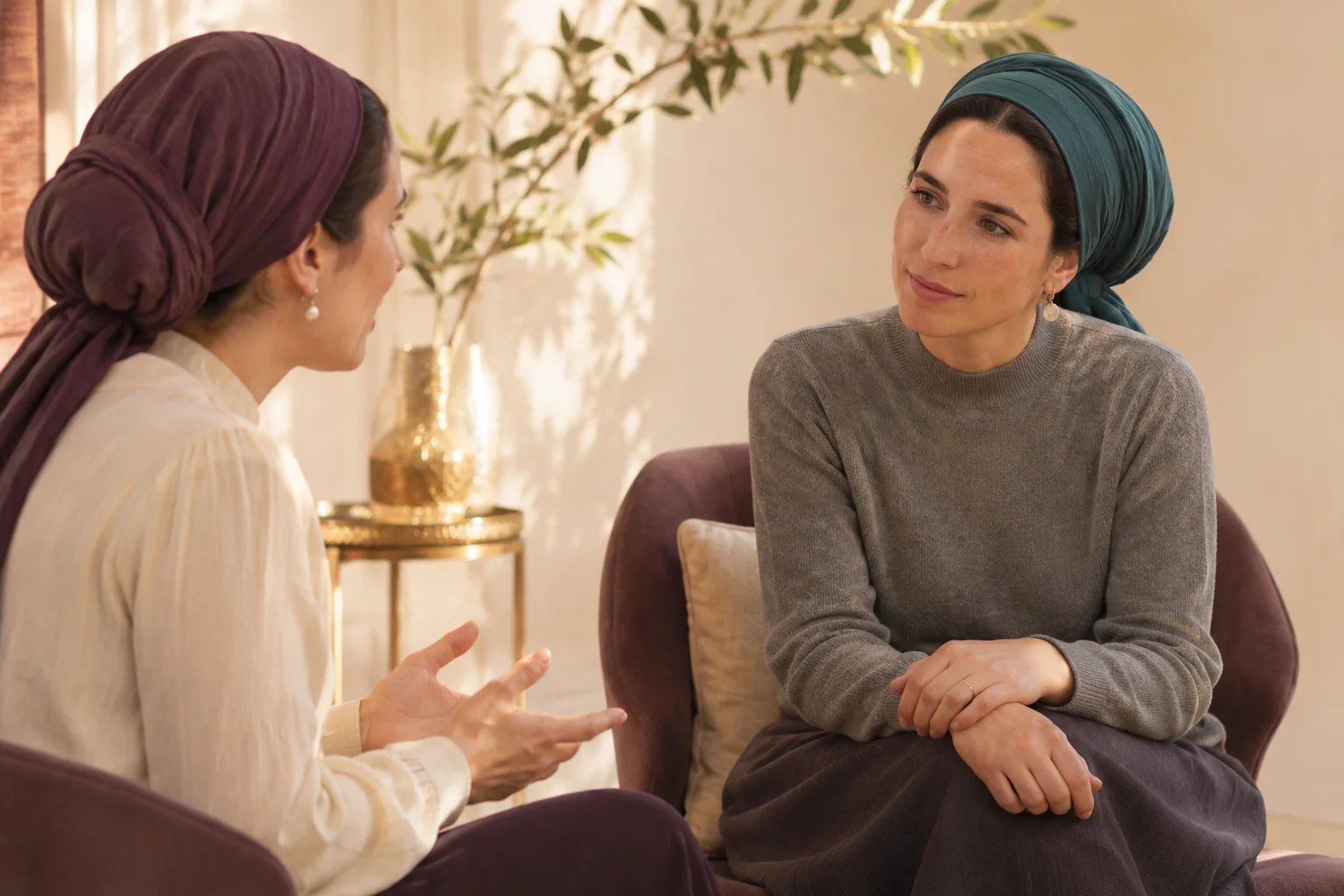
Deep work cannot begin on unsafe ground. So the first goal is trust. Many women carry trust that was broken over the years, sometimes by people who meant well. Underneath, there is often a broken trust in Hashem Himself, because her life has held so much challenge that it may not feel as if He was there for her.
Trust in Hashem is the ultimate aim, but it is rebuilt step by step, starting on the human level. A Torah-based guide listens the way we believe Hashem listens when we pour out our hearts: attentively, without interrupting, without rushing to interpret. She comes without an agenda of her own. Her direction is “the land that I will show you” (Bereishis 12:1): the place this woman’s neshama is meant to reach, which only Hashem fully knows.
One spiritual principle holds the whole process: Hashem is more compassionate than anyone. When the guide feels compassion for the woman in front of her, she knows that His compassion is greater still. He is in the room, leading her by the hand.
The Second Stage: Going Inward
Chava Shmilovitch reads Hashem’s words to Avraham, “Lech lecha,” as two movements: “lech,” be in motion, and “lecha,” go to yourself. Healing is a journey inward, into the depths of the neshama, taken gently and together.
In those depths we often find two kinds of roots. A weak root is a trait or need that never grew strong enough. For example, a woman who is taken advantage of again and again may discover that she grew up as the “pleasing child,” the one who took care of everyone and learned to abandon her own needs. A disconnected root is a deeper lack, such as a feeling of not belonging that has been with her since childhood.
Healing works on several levels at once. On the human level, she builds a kind, guiding inner parent who allows what was never allowed, like setting a boundary. She strengthens weak muscles, such as giving warmth to her children even if she did not receive it herself. And she connects the disconnected root to Hashem: if she has felt unloved since birth, she can connect to the source of infinite love, the One who chose to bring her into the world.
The Third Stage: Making Room for Pain

Before any of that can happen, the pain needs room. Over the light of the neshama there is often a layer of numbness, made of very painful feelings and the interpretations that keep them alive. So in almost every deep process, the wounded part of her is first given space to put its pain into words.
This is not a step away from emunah. “In all their suffering, He suffers” (Yeshayahu 63:9). Hashem feels the pain even more than the one who is hurting, and He wants to bring her out of it, just as Chazal say: more than the calf wants to nurse, the cow wants to give milk.
Once the pain has been heard, there is room for da’at, deep awareness. Rebbe Nachman teaches that all sorrow comes from a lack of da’at, and that one who truly knows everything is under Hashem’s providence has no suffering (Likutei Moharan 250). Da’at here is not an idea in the head. It is the joining of mind and heart in feeling Hashem’s support and love, even where the eye cannot yet see the good.
Why the Source Matters
As people who believe in Torah from Heaven, we know the Giver of the Torah did not leave us without counsel for our emotional lives. The One who created the human being knows her more intimately than any researcher could. Hidden in the inner teachings of the Torah is guidance that can heal the heart from anxiety, shame and grief, in a way that is deep, practical and professional.
Over more than twenty-five years, Chava Shmilovitch has built her processes and courses on these sources: the Ramchal, Nefesh HaChaim, Likutei Moharan, the Tanya, Rav Shimshon Pincus and many others. Women who had been disappointed by other approaches have found answers here, because the work reaches the spiritual root of the pain, and not only its surface.
Where to Begin
A good first step is the free Chiburim mini-course: four experiential classes on secure attachment with yourself, with Hashem and with the people closest to you.
For women ready to go deeper, Chiburim is Chava’s year-long online course. It is now in session, and you can join anytime. Classes are taught in Hebrew with English subtitles, and women learning in English receive a fully recorded English summary of every class, the course materials in English and an English support group.
A gentle note: this article is for learning and inspiration. If you are in crisis or in any danger, please reach out right away to your local emergency services or to a trusted professional.
Frequently Asked Questions
Is Jewish psychology a replacement for professional mental health care?
No. It is a path of inner and spiritual growth rooted in Torah. It can sit alongside professional care, but it does not replace it. If you are struggling with a mental health condition or feel unsafe, please speak with a qualified professional.
Who is this approach for?
For every woman: those who want deep personal growth, and those who coach, counsel or guide others and want tools rooted in Torah.
Can I learn with Chava if I don’t speak Hebrew?
Yes. Chiburim classes have English subtitles, and English learners receive a full recorded English summary of every class, English materials and an English support group.
Do I need a big crisis to benefit?
Not at all. Many women come because they want more calm, more joy and a closer connection with Hashem. Others come during a hard season.

